Public domain
Edvard Munch’s The Scream
17 October 2026
Few images in art history capture raw human emotion quite like Edvard Munch’s The Scream. With its undulating skies, stark lines, and the central figure clutching its face in existential agony, the artwork has become the universal symbol for modern anxiety. Created by the Norwegian Expressionist in 1893, the piece breaks away from realistic depiction, choosing instead to portray a deeply psychological, almost terrifying internal state.
The Inspiration Behind the Agony
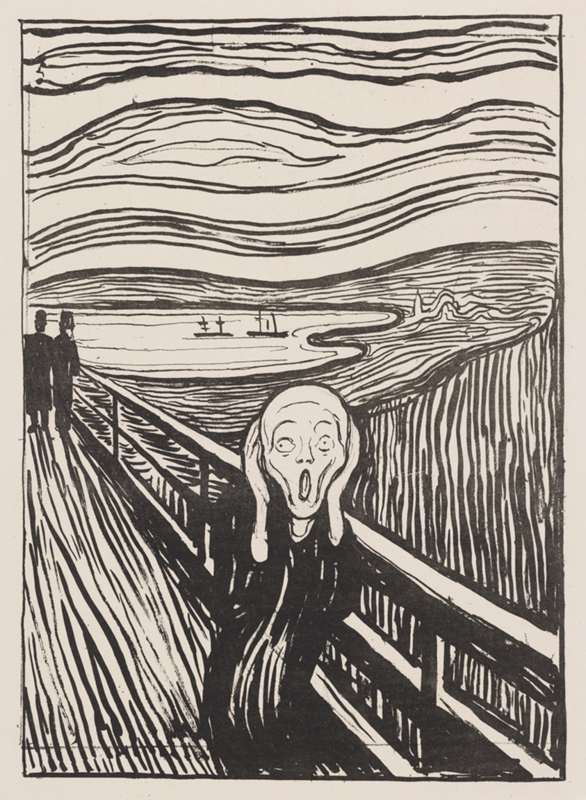
The story of how The Scream came to be is as haunting as the image itself. Munch was walking along a path near a fjord overlooking Oslo with two friends at sunset. As the sky suddenly turned the color of blood, he stopped, exhausted, and leaned against a fence. While his friends continued walking—you can see their dark silhouettes in the background of the image—Munch felt a sudden, paralyzing wave of dread.
In his diary, he later described the experience: “I stood there trembling with anxiety—and I sensed an infinite scream passing through nature.”
The figure’s mouth is open. Munch wrote that the scream passed through the landscape, and that the figure is holding its ears against that sound. The two friends are the dark pair still walking, on the left in the print below.
The Making of an Icon: Paintings vs. Prints
He returned to the picture more than once. Between 1893 and 1910 he made four main versions, in tempera, pastel, and crayon on cardboard. The best-known painted version is in the National Museum in Oslo.
However, realizing the immense popularity and emotional resonance of the composition, Munch wanted a way to share the image with a broader audience. In 1895, he created a lithograph stone of the artwork. This allowed master printers to pull striking, high-contrast black-and-white prints. By stripping away the blood-red colors of the painted sky, the lithograph forces the viewer to focus purely on the fluid, vibrating lines of the composition.
The two images featured below are surviving copies of that 1895 lithograph print run. One is housed at the National Gallery of Art (cataloged under its German title, Geschrei), and the other belongs to the Art Institute of Chicago.

Is The Scream in the Public Domain?
Munch died in 1944. In countries that use a term of the artist’s life plus 70 years, the work entered the public domain in 2015. In the United States a print published in 1895 was already public domain before that, because the term there follows the year of publication. These two files are the National Gallery of Art and the Art Institute of Chicago’s photographs of the 1895 lithographs.
A museum can still keep its own photograph of a painting off limits. The files here are photographs of the 1895 lithographs, printed in black. You can download them and use them for personal or commercial work.