Public domain
Four pictures by Vincent van Gogh
17 October 2026
Vincent van Gogh is one of the most recognizable names in art history, and his career as a painter lasted about ten years. In that time he made roughly nine hundred paintings and more than a thousand drawings. The color got brighter, the paint got thicker, and the line started to move. He was not only describing a place. He was recording how that place felt to him.
The Starry Night is the picture most people mean when they say his name. The four below are other chapters: Paris in 1887, the asylum at Saint-Rémy, the last months at Auvers, and a Dutch lithograph from before any of that color.
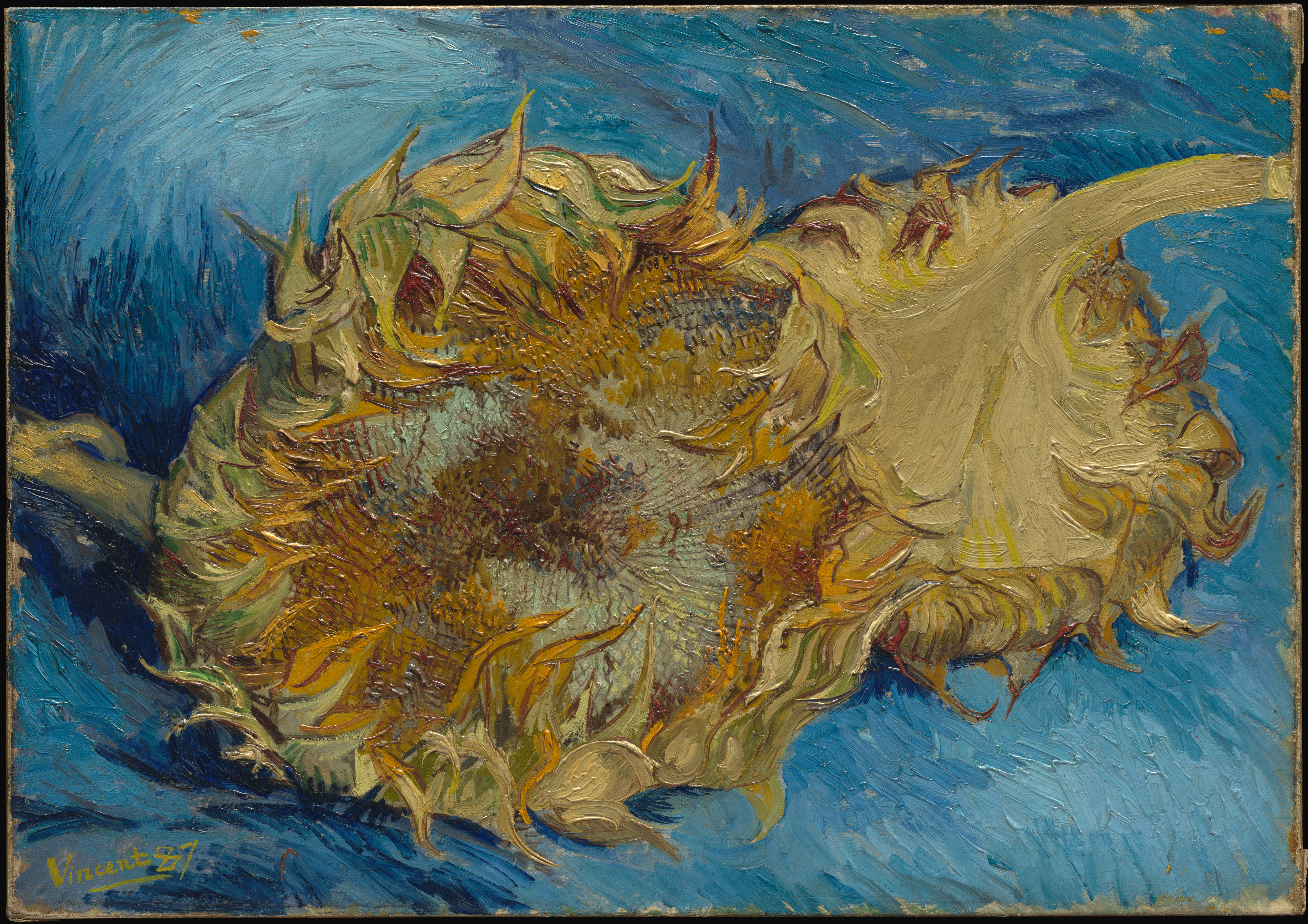
Paris, 1887: two cut sunflowers
A search for Van Gogh’s sunflowers usually turns up the yellow blooms standing in a vase, painted in Arles in 1888. The Sunflowers at the Metropolitan Museum of Art is a different picture, made in Paris in the late summer of 1887. There is no vase. Two cut heads lie on a strong blue ground, one seen face-on, the other from the side. He painted four sunflower still lifes in Paris that summer. This is one of them.
He had been looking hard at the Impressionists, and the dark brown pictures of his Dutch years were giving way. The paint is thick. Yellow, ocher, and green sit against that blue. The two heads are heavy and freshly cut.
Saint-Rémy, 1889: Wheat Field with Cypresses
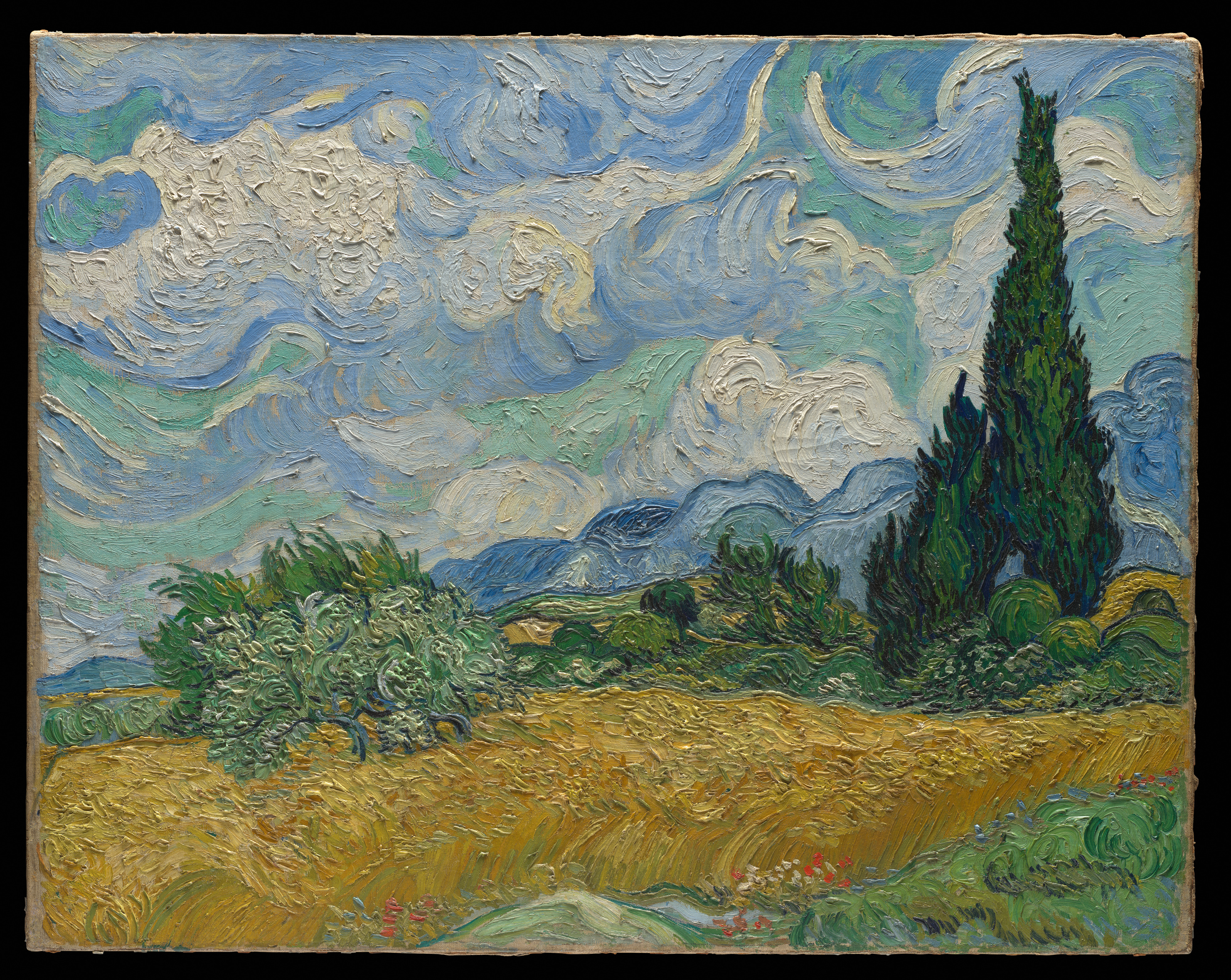
In May 1889 Van Gogh admitted himself to the asylum at Saint-Paul-de-Mausole in Saint-Rémy. Wheat Field with Cypresses, at the Met, was painted outdoors that summer, straight from the field. He thought well enough of it to make two more versions in the studio that September, one of them now in the National Gallery in London.
The wheat bends, the clouds tumble, and the hills sit in a band of blue. On the right are two cypresses, a tall one and a shorter one pressed against it. Cypresses had a long association with mourning. Van Gogh compared them to an Egyptian obelisk, and called them a splash of black in a sunny landscape.
Auvers, 1890: Green Wheat Fields
In May 1890 he left the asylum for Auvers-sur-Oise, a village outside Paris, to be nearer his brother Theo and Dr. Paul Gachet. He had about ten weeks. Green Wheat Fields, Auvers, at the National Gallery of Art, is from that last stretch. Nobody is in the field. The wheat runs in long green strokes under a heavy blue-and-white sky. Some of his earlier pictures put a sower or a peasant in the landscape. This one does not.

Nuenen, 1885: The Potato Eaters, on paper
Before France, Van Gogh was in the Dutch village of Nuenen, painting the people who worked the land. The Potato Eaters was his first large figure picture. He wrote to Theo that he had tried to show people eating potatoes by lamplight who had dug the earth with those same hands. The oil painting is in the Van Gogh Museum in Amsterdam.
The file here is the lithograph he made the same year, printed in dark brown, not black. He wanted copies he could send to people who would never see the canvas. The print reverses the painting, which you can still see in the signature: “Vincent” reads backward. The faces, the lamp, and the crowded room are the picture. The paint surface in Amsterdam is not.

Downloading these, and not The Starry Night
Van Gogh died in 1890, so the paintings and the print are in the public domain. What a museum may still hold back is its own photograph of a painting. The Starry Night is not here because the Museum of Modern Art has not released a free, high-resolution photograph of it.
The Met and the National Gallery of Art have released photographs of these four: the 1887 cut sunflowers, the 1889 wheat field, the 1890 wheat field, and the 1885 lithograph. You can download them and use them for personal or commercial work.