Public domain
Monet’s water lilies
17 October 2026
When people think of Claude Monet’s Water Lilies, they often imagine a single, definitive painting. In reality, Monet spent over twenty-five years obsessively painting the lush water garden at his home in Giverny. The result wasn’t just one masterpiece, but a series of roughly 250 distinct oil paintings that evolved dramatically over time.
The images featured below represent entirely different canvases painted years apart, capturing his journey from traditional Impressionist landscapes to near-total abstraction.
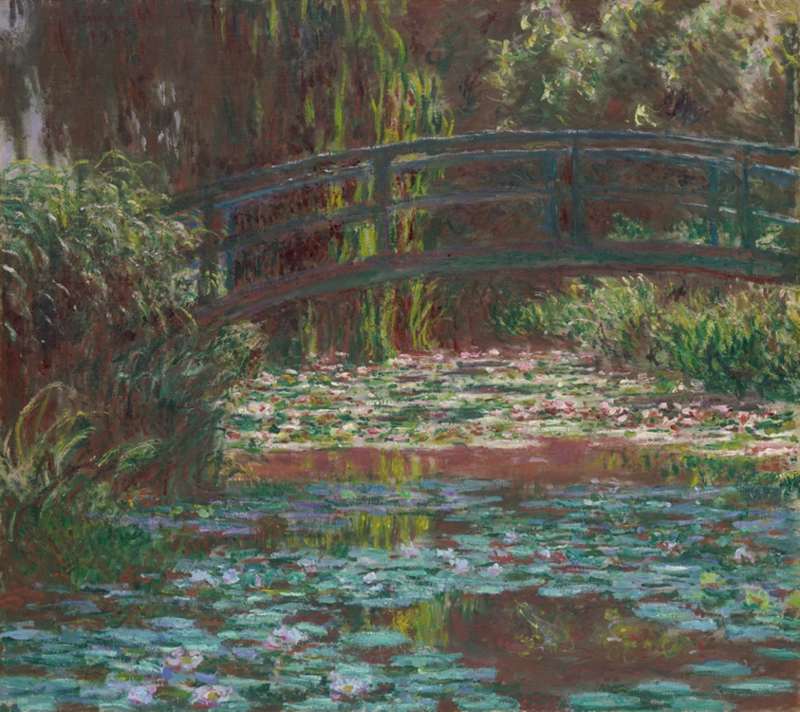
Early Years: Grounded by the Bridge
The Japanese Footbridge (1899), at the National Gallery of Art, shows the green arch, the bank, and the lilies. Water Lily Pond (1900), at the Art Institute of Chicago, has the bridge again, with willow hanging over it. Both were painted before his cataracts were diagnosed in 1912. The 1899 canvas is the brighter garden. The 1900 canvas is darker and heavier.

Immersion: When the Pond Fills the Canvas
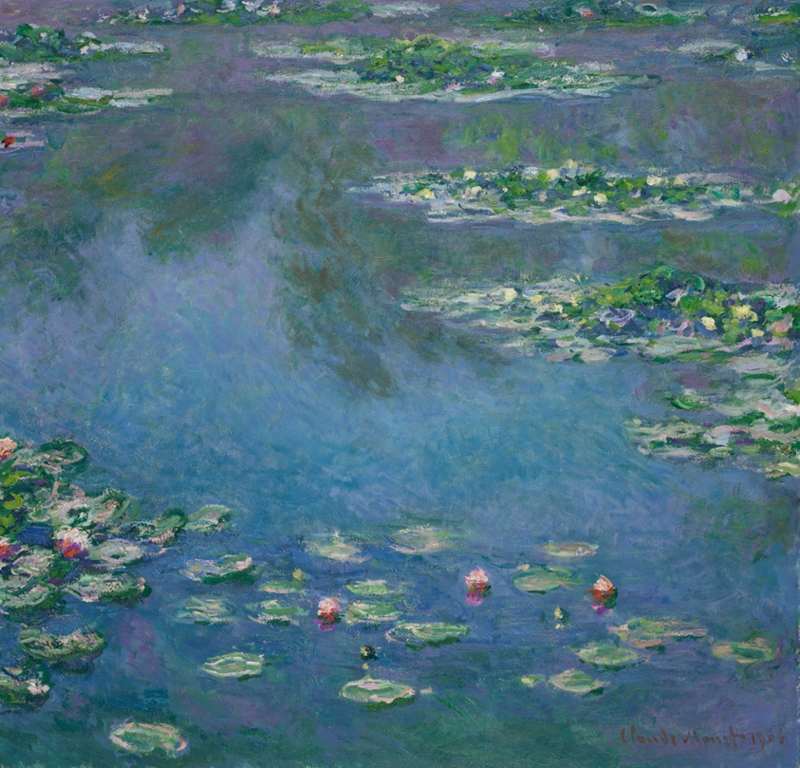
As the years passed, Monet’s perspective shifted downward. By the time he painted Water Lilies in 1906 (Art Institute of Chicago), he had eliminated the horizon line and the shoreline entirely.
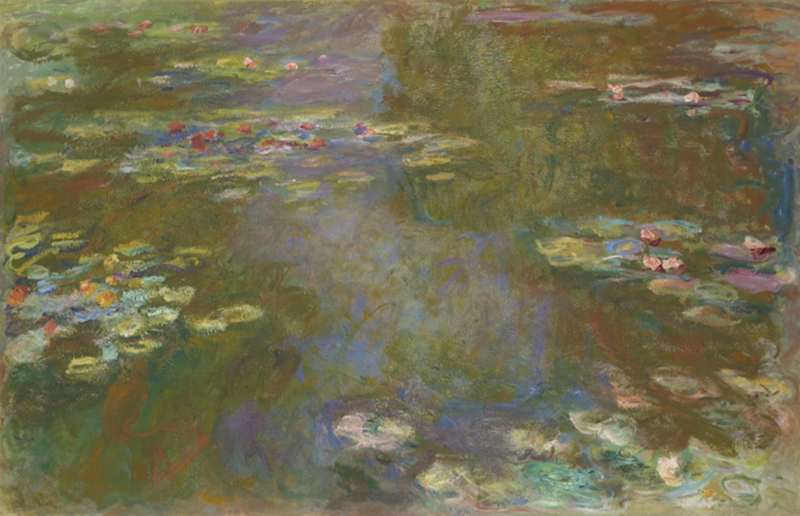
By Water Lilies of 1906, at the Art Institute of Chicago, the bridge, the bank, and the horizon are gone. What is left is the surface of the pond: pads, a few flowers, and blue water. Water Lily Pond of 1917–19 stays on the water. The strokes are looser, and there is still no bridge.
The Impact of Failing Eyesight on His Late Work
One of the most profound influences on Monet’s late style was not just a deliberate artistic choice, but a medical reality: his failing eyesight. Around 1912, Monet began developing cataracts in both eyes. As proteins built up and clouded his lenses, his vision blurred, and the vibrant world he loved took on a muddy, yellowish-brown tint.
Around 1912 he was told he had cataracts in both eyes. As the lenses clouded, vision blurred and color shifted. He told his doctors that reds looked muddy, that pinks looked dull, and that he could no longer see color with the same strength. By the early 1920s the right eye could barely tell light from dark, and he labeled his paint tubes so he would not pick up the wrong color.
Water Lilies (Agapanthus), at the Cleveland Museum of Art, is mostly violet, green, and pale pads, with a small warmer cluster of flowers at the lower right. Cleveland dates it about 1915 to 1926, across the cataract years and the years after surgery.
In 1923 the cataract was removed from his right eye. The recovery was rough. At first he said he saw almost nothing but blue, and a second procedure followed. He went back to painting, and he destroyed canvases he decided had failed, as he had at other times. Later writers have compared that loose brushwork to abstraction.

Are Monet’s Water Lilies in the Public Domain?
Yes. Claude Monet passed away in 1926, meaning his original paintings have long since entered the public domain.
The paintings are free of copyright. What you download is each museum’s photograph of its canvas. Cleveland marks its file CC0. The National Gallery of Art and the Art Institute of Chicago mark theirs public domain. You can use them for personal or commercial work. The terms are not identical in every country, so read the museum’s record if the project will be published outside the United States.